
Home Garage Car Lifts: Two-Post vs Four-Post and What Actually Fits
A lift is the biggest garage upgrade most enthusiasts ever buy, and the one most often bought before anyone measured. Here's how to pick the right type and confirm it fits your ceiling, floor and wiring first.
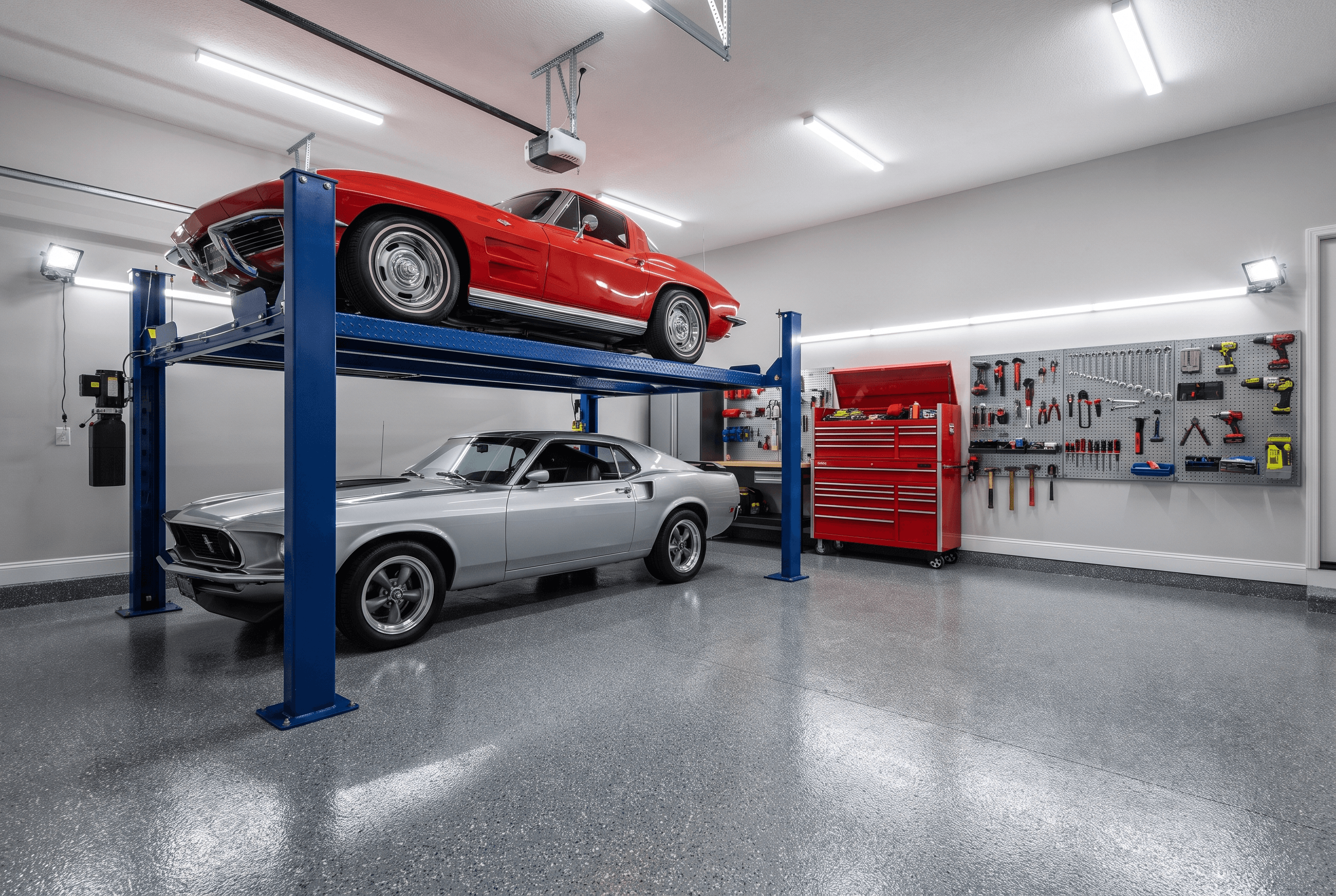
The best car lift for a home garage is the one that matches what you actually want it to do, and that fits your ceiling, your concrete and your wiring. If you mainly want to park two cars in one bay, a four-post storage lift is the answer. If you mainly want to work on suspension, brakes and exhaust with the wheels hanging free, a two-post lift is the better tool. If your ceiling is low, or the garage has to stay a garage, a scissor or portable lift covers most jobs without permanent posts.
Most lift regret comes from getting the order wrong: picking a model, then discovering the garage door track is in the way, or the slab is thinner than the manual requires. This guide works the other way round. Decide what the lift is for, then measure, then check the floor and power, then shop. Nothing here replaces the installation manual for the specific lift you're considering. Height, width, slab and electrical figures vary by manufacturer and model, and the manual is the document that counts.
Start With the Job: Storage or Service
Every lift is a compromise between parking and working. Be honest about which one you'll do more of.
- Mostly storage. A classic that sits through the winter while the daily driver parks underneath it. You want a drive-on lift that holds a car level for months, ideally with a drip tray between the decks so the top car doesn't mark the bottom one.
- Mostly service. Oil changes, brake jobs, exhaust, transmission work, suspension rebuilds. You want the wheels off the ground and clear access to the underside, which favors lifting by the frame or body rather than by the tires.
- Both. Possible, but every type is better at one than the other. A four-post with rolling bridge jacks can lift the wheels clear for brake work. A two-post can park a car overhead, but it's not designed to be a long-term storage lift, so check what the manufacturer says about leaving a vehicle raised.
If the car is going into storage either way, our guide to winterizing a classic car covers the fluids, battery and tire prep that should happen before it goes up.
Two-Post vs Four-Post: The Real Differences
Four-post lifts are drive-on. You roll the car onto two runways, set the parking brake and raise it. Nothing touches the body, which matters on a car with fragile rockers, fresh paint or questionable floor pans. They are the easiest to use solo and the natural choice for stacking two cars. Many home-market four-posts can be fitted with a caster kit so the lift can be moved around the garage, which also means a free-standing four-post may not need anchoring at all. Check the manual on that point. The trade-off is that the wheels sit on the runways, so suspension, brake and wheel work needs a rolling bridge jack to lift the axle off the deck.
Two-post lifts raise the car by its frame or body lift points on four swing arms, leaving the wheels and suspension hanging. That's the layout most shops use for a reason: it gives the best access underneath. The costs are that you need to position the car carefully every time, both posts must be anchored into concrete that meets the manufacturer's requirements, and you need to know where your car's lift points are. On a body-on-frame classic that's usually the frame. On an older unibody it may be specific reinforced points, and on a car with rot in the rockers or floors, lifting by the body may not be safe at all until the metal is repaired.
Two-post lifts come in two arrangements worth knowing:
- Symmetric lifts use equal-length arms with the columns facing each other, centering the car between them. They suit longer, heavier vehicles such as trucks.
- Asymmetric lifts use shorter front arms and rotated columns, which sets the car further back so the doors open between the posts. That's a real advantage in a narrow home bay where you need to get in and out of the car while it's on the lift.
There's also the floor or ceiling question. A floorplate two-post routes its cables and hydraulic lines across the floor under a raised cover you drive over, so it works under a lower ceiling. A clear-floor two-post runs them through an overhead beam, which leaves the floor flat but needs more height.
One safety point specific to two-posts: the car is balanced on four pads, so its center of gravity matters. Pulling an engine or transmission, or a heavy rear axle, shifts that balance a long way. Follow the manufacturer's guidance before removing major components from a car on a two-post lift, and use tall under-hoist safety stands to support the car where the manual allows it.
Scissor and Portable Lifts
If posts won't fit, or you don't want them in the garage full time, there are two other categories.
Mid-rise and low-rise scissor lifts lift the car by its frame or lift points from underneath, with no columns. They don't get the car to standing height, but they get it high enough for comfortable wheel, brake and body work from a rolling stool, and some models can be moved or recessed. The center of the car is often partly blocked by the scissor mechanism, so check where the pads land before buying.
Portable lifts are the lowest-commitment option. The best known is QuickJack, a pair of hydraulic frames that slide under each side of the car and lift it about two feet. BendPak's current QuickJack models are rated from 5,000 to 8,000 pounds, and the company says the newer 6000 and 8000 series are ALI certified. Two feet won't let you stand under the car, but it's a big step up from jack stands, it stores against a wall, and it needs no anchoring, no special ceiling and no slab work. For a rented garage, or a single-car garage that still has to park a car, it's often the right first lift.
Measure Before You Shop
This is the step that decides what fits. Get a laser distance measure and write these down:
- Lowest point of the ceiling, not the average. Measure to the bottom of the garage door when it's open, the door track, the opener rail and motor, light fixtures and any beam or duct. In many garages the open door is the real ceiling.
- Bay width and length. Measure between walls and to any shelving, water heater or step. Compare it against the lift's overall width and length from its spec sheet, then leave room to walk around it with a tool cart.
- Vehicle heights. Both cars, if you're stacking. Measure the tallest point, not the brochure figure. A roof rack, antenna or tall convertible top changes the answer.
- Door path. Where the garage door travels when it opens, and whether a raised car would hit the door, track or opener.
For a storage lift, the basic check is: the lift's maximum height to the top of the runways, plus the height of the car parked on top, plus a safety margin, must be less than your lowest overhead obstruction. Then confirm that the car parked underneath clears the bottom of the raised runways and any drip trays. Manufacturers publish the runway and rise figures in each model's spec sheet. For example, a seller listing for BendPak's HD-9XW storage lift gives 87 inches as its maximum lifting height to the top of the runway, which tells you immediately that a car on top of it needs a lot more than a standard 8-foot ceiling to rise all the way.
A lift doesn't have to go all the way up to be useful, and many have multiple lock positions. If you can't get the height to work at the top lock, check whether a lower lock still leaves room to park the car underneath.
If the garage door is the problem, it's often fixable. A wall-mounted jackshaft garage door opener removes the center rail and motor from the ceiling, and a garage door company can quote a high-lift track conversion that raises the door's resting position toward the ceiling. Both are jobs for a door professional, because garage door springs store a lot of energy.
The Concrete: Thickness, Strength and What's Inside It
A lift's columns put a concentrated load on a few square feet of concrete, and the anchors depend on the slab around them. Every manufacturer specifies a minimum slab thickness and a minimum concrete strength, usually in psi, and they differ by model and by type of lift. Read the requirement for the specific lift in its installation manual rather than relying on a figure you saw online.
Before you drill anything, find out:
- How thick the slab is where the posts will go. Slabs are often thinner at the edges, or vary across the garage. A small test hole drilled in the post location, measured with a wire, tells you what's actually there.
- How old it is. New concrete needs time to cure before it reaches its design strength, so a freshly poured pad isn't ready for anchors the week it's finished. Ask the contractor when it will be.
- Whether it's post-tensioned. Some slabs contain steel cables under high tension. Drilling into one can cut a cable, which is both dangerous and expensive. Many homes built on post-tensioned slabs have a stamp or warning in the garage. If you're unsure, ask the builder or a structural engineer before drilling.
- What runs through it. Radiant heat tubing, electrical conduit and plumbing can all be in a garage slab.
- Its condition. Cracks near the post location, or a slab that has heaved or settled, are warning signs.
If the slab doesn't meet the specification, the usual fix is to cut out the post locations and pour new, thicker footings to the manufacturer's dimensions. A drive-on four-post that is approved for free-standing use sidesteps much of this, which is one reason they're popular in homes.
Power and Hydraulics
Most lifts use an electric motor driving a hydraulic pump. Home-market lifts are commonly offered with either a 110 to 120-volt or a 208 to 240-volt motor, and the higher voltage typically raises the car faster. Check what circuit the specific power unit requires, including the breaker size, and whether it needs a dedicated circuit. If the garage doesn't already have the right circuit, budget for an electrician.
You'll also need the hydraulic fluid the manufacturer specifies, which is often not included. Some lifts use air to release the safety locks, which means running an air line from a compressor. Others release the locks manually or electrically. That's worth knowing before you buy, if you don't already own a compressor.
Certification, Inspection and Permits
The single most useful thing to check on any lift is whether it's certified by the Automotive Lift Institute. ALI certification means an independent lab, such as Intertek (ETL), has tested that model to the ANSI/ALI ALCTV safety standard. That testing covers the structure, the controls and load-holding devices, lowering speeds and overload protection, and the factory's quality control is reviewed too. Certified lifts carry ALI's gold certification label. Some lifts on the market display badges designed to look like certification, so check the model against ALI's own online directory of certified lifts.
Certification is voluntary for a lift to be sold in the United States, and certification of the model is not the same thing as inspection of your installed lift. The ANSI/ALI ALOIM standard calls for vehicle lifts to be inspected at least annually by a qualified lift inspector, and ALI keeps a directory of certified inspectors. Those requirements are written mainly with commercial shops in mind, but a yearly inspection is cheap insurance for a machine you'll be standing under.
Whether a home installation needs a building or electrical permit depends on where you live, and so do homeowners association rules and how your homeowner's insurance treats it. Check with your local building department and your insurer before installation, not after. Also check whether an accessory, such as an aftermarket adapter or jack, is approved for your lift. An unapproved accessory can void the certification.
The Little Things Buyers Forget
- Delivery. Lifts usually arrive by freight truck, sometimes as a single crate weighing many hundreds of pounds. Check how it will be unloaded, especially if the truck has no liftgate.
- Installation. Many owners install their own, but it's a two-person job at minimum and the manual has to be followed exactly. Professional installation is offered by many sellers and is worth considering for a two-post.
- Drip trays. On a storage lift, plastic drip trays between the runways keep oil, coolant and brake fluid from the top car off the one below.
- Lift pads and adapters. On a two-post, rubber lift arm pads protect pinch welds and frames. Replace them when they get worn or cracked.
- Daily habits. Always lower the car onto the mechanical safety locks before you go under it, and never work under a car held only by hydraulic pressure.
With the car finally up at eye level, it's a good time to tackle the jobs on our list of off-season garage projects for classic cars. When spring comes and it comes down for good, find a car show this weekend to take it to.
Frequently Asked Questions
How high does a garage ceiling need to be for a car lift?
It depends on the type of lift and the vehicles. For a storage lift, add the lift's maximum height to the top of its runways to the height of the car parked on top, plus a margin, and compare that to your lowest obstruction, which is often the open garage door. Scissor and portable lifts work under normal ceiling heights because they only raise the car a few feet.
Is a two-post or four-post lift better for a home garage?
A four-post is better for storage and stacking two cars, is easier to use alone, and may not need anchoring. A two-post is better for repair work because the wheels and suspension hang free. Choose based on whether you'll mostly park or mostly wrench.
How thick does concrete need to be for a car lift?
There's no single number. Each manufacturer sets a minimum slab thickness and concrete strength for each model, and two-post lifts are usually the most demanding. Check the installation manual for the exact lift, then measure your slab at the post locations before drilling.
Can I install a car lift myself?
Many owners do, but it takes at least two people, the right tools, and strict adherence to the manufacturer's instructions, especially for anchoring and hydraulic connections. If you're not confident, professional installation is available from many sellers, and an annual inspection by an ALI certified inspector is a good idea either way.
Keep Reading
Find Your Next Car Show
Browse hundreds of upcoming shows, cruise-ins, and meets near you.
Browse Events