
How to Protect a Classic Car From Theft: Locks, Trackers and Smarter Storage
Most classics have no immobilizer, so the job falls to you. Here's how to layer visible deterrents, hidden cutoffs, trackers and smarter storage so your car is the hardest one to take.
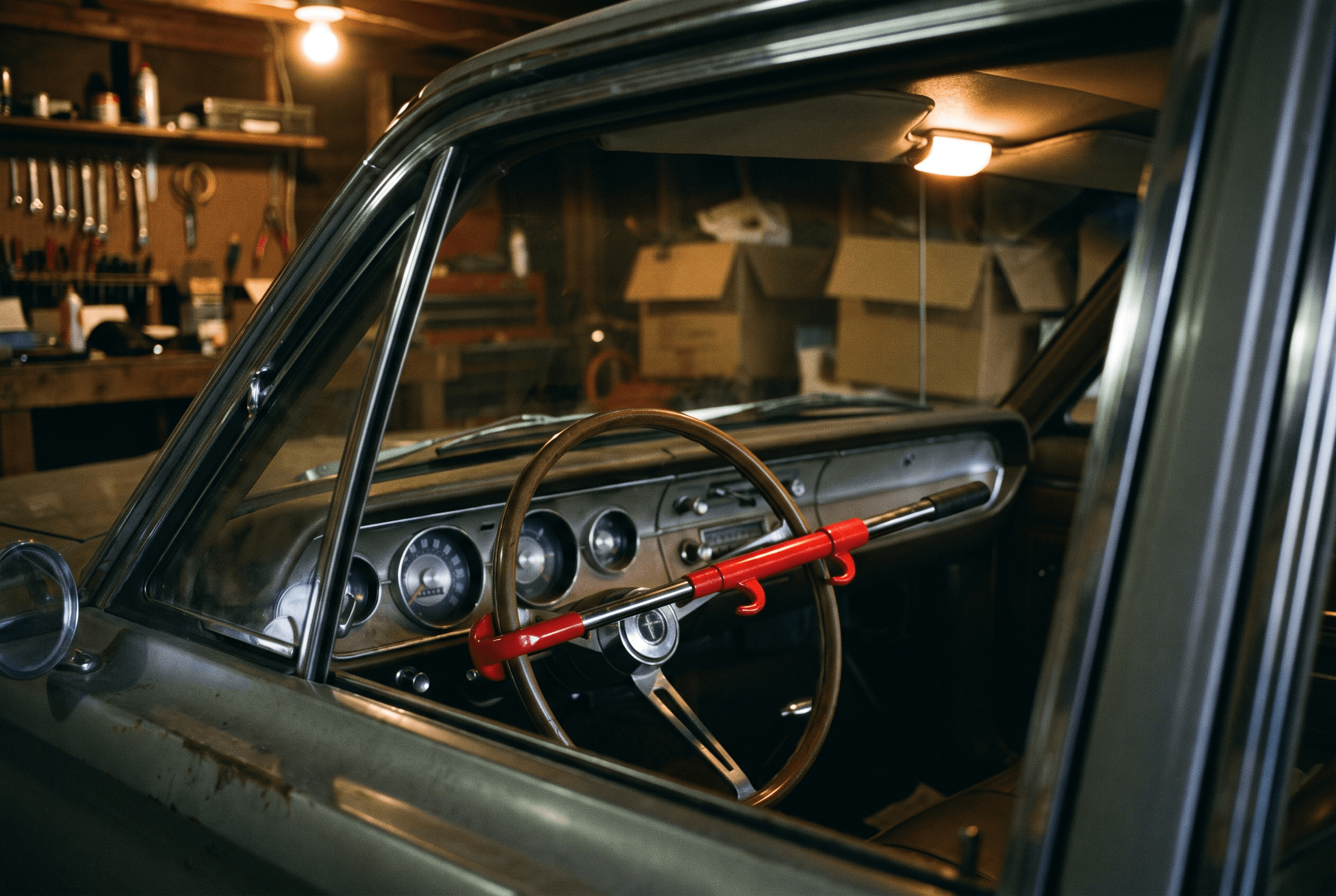
Protecting a classic car from theft comes down to layers. Most older cars have no electronic immobilizer, the ignition locks are decades old and often worn, and many will start with a screwdriver or a few jumper wires. So the protection that a modern car builds in has to be added by you: something a thief can see that makes them pick another car, something they can't see that stops the engine running, something that tells you where the car is if both fail, and storage that keeps a thief from getting to it in the first place.
No single device does all of that, and none is unbeatable on its own. The goal is to make your car slower, noisier and more annoying to take than the next one. This guide walks through each layer in the order a thief would meet it, then covers the habits that matter at home, in storage, on a trailer and on show day.
Layer One: Visible Deterrents
A visible lock does its best work before anyone touches the car. Someone walking a parking lot or peering through a garage window is looking for a quick job, and a bright bar across the steering wheel tells them this one won't be.
- Steering wheel locks. The classic bar-style lock, such as The Club, hooks across the wheel rim and blocks it from turning. Full-face designs that cover the whole wheel and hub are harder to defeat, because a thief can't simply cut the rim. On a thin-rimmed or wood wheel, check that the lock's hooks are padded and that it fits without stressing the rim.
- Pedal and shifter locks. A lock that ties the brake or clutch pedal to the steering wheel, or a brake pedal lock that clamps the pedal itself, gives a second visible barrier on a different part of the car.
- Wheel clamps. A tire clamp boot is the most obvious deterrent there is. It's bulky and slow to fit, so it suits a car that sits for weeks at a time rather than one you drive every weekend.
- Window decals. A sticker announcing a tracker or alarm costs almost nothing. It only works if it's believable, so pair it with the real thing.
A determined thief with time and power tools can get through any of these. That's fine. They're there to change the choice, not to win a fight.
Layer Two: Hidden Kill Switches and Cutoffs
A hidden kill switch is the classic owner's substitute for a factory immobilizer: a switch only you know about that interrupts a circuit the car needs to run. Where you put it matters as much as whether you have one. There are three common circuits to cut, and each fails differently:
- Ignition (coil primary). Interrupting the feed to the coil stops spark entirely. Simple on a points or early electronic ignition car. A knowledgeable thief can trace and bypass it, so the switch location has to be genuinely hidden.
- Starter trigger. Cutting the wire that energizes the starter solenoid means the key turns and nothing happens. On its own it can be beaten by push-starting a manual car or jumping the solenoid, so it works best combined with another cutoff.
- Electric fuel pump. If the car has one, cutting its feed lets the engine start and run on what's in the carburetor bowl, then stall a short distance away. Many owners like that, because a thief abandons a car that dies in the street. It does nothing on a car with a mechanical pump.
Two points that separate a good install from a fire risk. First, the switch must be rated for the current in the circuit, or it should trigger a 12V automotive relay that carries the load instead. A small toggle switch spliced into a heavy circuit will overheat. Second, use proper crimped or soldered connections, heat shrink and a fuse, and match the wiring to the car: a 6-volt or positive-ground system changes how relays and indicators should be wired, so read the instructions for that setup or have an auto electrician do it.
For hiding the switch, avoid the obvious spots under the dash on the driver's side, which is where a thief looks first. Inside the console, under the seat frame, behind a kick panel, or wired to an existing control that looks original all work better. On a show car, a switch that's invisible to judges is worth the extra wiring.
Layer Three: Battery Disconnects
A battery cutoff stops the car dead and also ends parasitic draw while it sits. The theft value depends on the type. A knob-style battery disconnect switch on the battery post is quick to use but just as quick for anyone who lifts the hood. A rotary battery switch with a removable key, mounted inside the trunk or cabin, is better: take the key with you and there's no power to anything.
The trade-off is that a cutoff kills clocks, radio presets and any alarm or tracker that runs off the main battery. If you use a hardwired tracker, wire it so it stays powered, or choose one with its own backup battery. Our guide to battery tenders and trickle chargers covers how a disconnect fits with keeping the battery healthy through storage.
Layer Four: GPS and Bluetooth Trackers
A tracker doesn't stop a theft. It improves the odds of getting the car back. It's worth knowing exactly what each kind can and can't do before you rely on one.
- Cellular GPS trackers report the car's position over a mobile network, usually to a phone app, and many can send an alert when the car moves or leaves a set area. Most need a monthly or yearly data plan. They need cell coverage to report, and a unit buried behind metal may get a weaker GPS fix. Hardwired units draw a small current from the car; battery-powered ones need recharging. Compare current hardwired GPS car trackers on plan cost and coverage as much as on hardware price.
- Bluetooth item trackers such as Apple's AirTag have no GPS of their own. They report their location through nearby phones on the maker's network, so they work well in a city and poorly in a rural barn. They also have anti-stalking features: Apple says an AirTag separated from its owner can trigger an "AirTag Found Moving With You" alert on a nearby iPhone, and can play a sound when moved. That means a thief carrying a phone may be told it's there. Treat one as a cheap backup, not your main plan.
Hide any tracker somewhere a quick search won't find it, and consider running two different types so finding one doesn't end the trail. If the car is stolen, call the police first and give them the tracker's location. Don't try to recover it yourself.
Storage Security: Home Garage and Storage Units
For most owners the car spends most of its life parked, so this is where security pays off most.
At home, start with the garage door. Many openers have an emergency release cord that can be pulled from outside by someone working a hooked wire through the top of the door. A release shield, or a door with a keyed outside release, makes that much harder, but keep the release working from inside, because it's there for your safety. Don't leave the opener remote in a car parked in the driveway, cover garage windows so the car isn't on display, and add motion lighting and a camera that records off-site. A garage door lock or a lockout switch on the opener helps when you're away for an extended stretch.
In a storage unit, ask before you sign: is the gate access logged by individual code, are there cameras on the aisles rather than just the entrance, and are units individually alarmed? A disc padlock with a shrouded shackle is much harder to cut than a standard padlock. Check what your own insurance covers in a storage facility, because the facility's contract often limits its liability.
Wherever the car sits, a locked cover adds another delay. A cable threaded through the cover's grommets and locked under the car stops the cover walking off and slows down anyone trying to get at the car beneath it.
Trailers, Hotels and Show Days
A classic on a trailer is a car someone can steal without starting it. Lock the trailer as well as the car:
- A trailer coupler lock when the trailer is unhitched, and a locking hitch pin when it's hitched, so the whole rig can't be swapped onto another truck.
- A wheel lock or boot on the trailer itself at overnight stops.
- At hotels, park somewhere lit and visible, ideally in view of your room or the front desk, and back the trailer against a wall or curb if the lot allows it so the ramp or doors can't open.
- Keep the car's own locks and cutoffs active while it's on the trailer.
Our car show road trip guide covers the rest of the planning for overnight travel. On show day, keep the keys on you rather than in the ignition or on the seat, and don't leave the title, a spare key or the registration with your home address in the glove box. At the end of the day, when crowds thin and cars are being loaded, is when to keep an eye on the car.
Paperwork That Helps Recovery
If the worst happens, police and insurers need to identify the car fast. Keep a file, stored away from the car, with the VIN, the engine and transmission numbers, any trim tag or body numbers, and clear photos of the car from every angle plus close-ups of distinctive details: dents, a repaired seat, an odd part. Record anything unique you've marked or fitted. A car with a documented history and photos is easier to prove is yours.
Be careful what you post online, too. A photo of the car in your driveway can reveal where it lives, and many phones embed location data in the photo file. Strip that data before posting, or take showcase photos away from home. Rules on vehicle registration, reporting a theft and what an insurer requires vary by state and by policy, so check with your state and your insurer rather than assuming. Many insurers ask about anti-theft devices when quoting, and some offer discounts for them, so mention what you've fitted.
With the car locked down, you can enjoy it with less worry. Find your next car show this weekend.
Frequently Asked Questions
What is the best anti-theft device for a classic car?
No single device is best. Layered protection works: a visible steering wheel or pedal lock, a hidden kill switch or keyed battery cutoff, and a tracker. Each one covers a weakness in the others.
Does a kill switch really stop car thieves?
A well-hidden kill switch stops most opportunistic thieves, because the car won't start or won't keep running. It can be found and bypassed by someone with time and knowledge, which is why it works best combined with a visible lock and a tracker.
Can I use an AirTag as a car tracker?
You can, as a backup. An AirTag relies on nearby Apple devices to report its location, so it works best in populated areas, and its anti-stalking alerts may tell a thief with an iPhone that it's there. A cellular GPS tracker is more reliable as the primary tracker.
Where should I hide a GPS tracker in a classic car?
Somewhere a quick search won't find it and where it can still get a signal, such as inside a seat, behind interior trim or under a plastic panel rather than buried behind thick metal. Test the signal from the hiding spot before you finish the install.
Keep Reading
Find Your Next Car Show
Browse hundreds of upcoming shows, cruise-ins, and meets near you.
Browse Events