
Modern Sound, Vintage Dash: Hidden Audio Upgrades for Classic Cars
You can stream music in a classic and keep the dash uncut. Here are the options from least to most invasive, where speakers and amps can hide, and the wiring checks that come first.
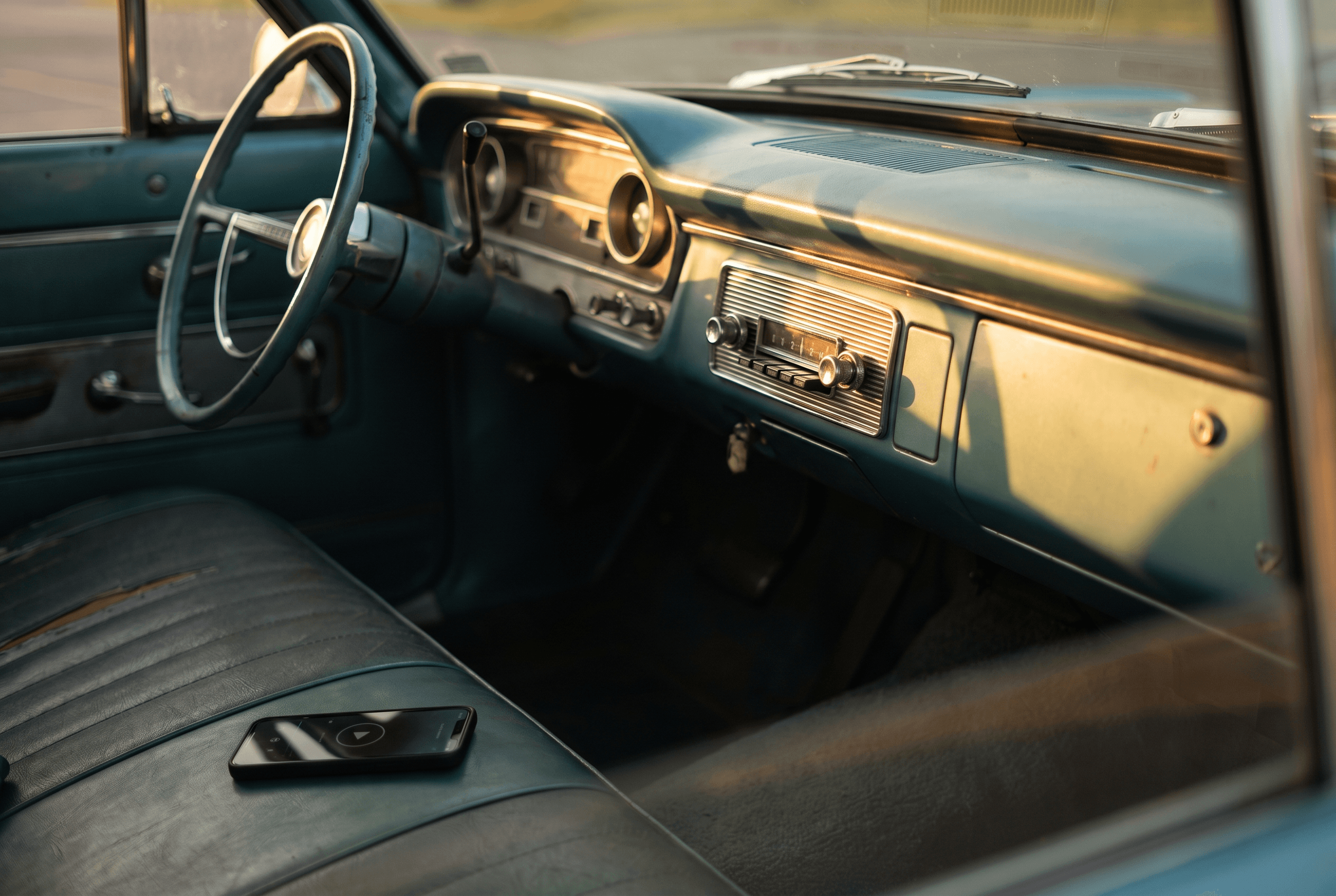
You can put modern sound in a classic car without cutting the dash, and the best hidden audio upgrades leave the original radio exactly where the factory put it. The options run from a Bluetooth adapter or small amp feeding the stock radio, through an internal conversion of that radio, to a retro-look unit that fits the factory opening, and finally to a fully hidden system you run from your phone. Every one of them can be done without a saw.
The rule that ties them together is reversibility. Keep every original part in a labeled box, use the factory openings and mounting points, and don't cut anything you can't buy again. A car that can go back to stock in an afternoon keeps its options open for judging, for resale and for the next owner.
Option 1: Feed the Original Radio
The least invasive route leaves the stock radio untouched and adds a small box behind the dash. Most original radios are AM-only with no input for a phone, so the common approach is a separate hidden Bluetooth amplifier: the original radio stays in the dash for looks and for AM, and the phone streams to the new amp, which drives the speakers. Sports Car Market has described this exact approach as a way to keep the factory AM radio while adding a completely hidden unit controlled from your phone.
The trade-off is honest and worth knowing before you start. With two separate audio paths, you either switch the speakers between them or accept that the original radio becomes mostly decorative.
Option 2: Convert the Stock Radio From the Inside
An internal conversion keeps the original faceplate, knobs, dial and chassis, and replaces the guts with modern electronics. Specialist shops do this for many period radios, and drop-in conversion boards exist for some popular units, such as the Aurora Designs FMR tuner that adds AM, FM and Bluetooth to older radios.
This is the choice for a car that will be judged on originality, because the part in the dash is still the original part. It is also the hardest to price without a quote, since the work depends on the radio, its condition, and whether the shop has done that model before. Send the shop the radio's make and part number first, and ask it to return any original internals it removes.
Option 3: A Retro-Look Unit in the Factory Opening
If the original radio is missing, dead, or not worth converting, a reproduction-style unit that fits the factory shaft opening is the next step. RetroSound's RetroRadio uses adjustable brackets that set the shaft width and depth so the face sits flush in the original holes, and the company lists fitments for well over a thousand classic vehicles. Its current radio "motors" all include Bluetooth, and the higher models add USB and HD Radio. Custom Autosound sells shaft-style units in the same spirit, such as the USA-230.
The catch is that it looks period-correct, not period-original. A judge in an originality class will know, and some owners simply prefer the real thing. Check the maker's vehicle-fitment tool before ordering, because faceplates and shaft spacing vary by year even within one model line.
Some retro-look units also offer phone integration and screens. Adding CarPlay or Android Auto is a bigger question about screens and dash space, and it gets its own guide; this one stays with sound.
Option 4: A Fully Hidden System
The most complete upgrade puts a modern head unit out of sight and leaves the dash completely stock. Custom Autosound's Secretaudio line is the best-known example: the main unit mounts behind the dash, under a seat or in the trunk, a small LCD display can hide in a glovebox or ashtray, and the current SST version includes Bluetooth and a USB input along with a remote that doesn't need line of sight.
Because nothing in the dash changes, this route suits owners who want real power and a modern feature set without visible clues. It is also the most work to install, since every speaker, power and ground wire runs fresh. Leave the original radio in the dash, even if it no longer plays, so the dash looks complete.
Speakers That Fit Without Cutting
Most classic cars came with one speaker in the dash, wired for a mono radio. Upgrading the head unit without dealing with that one speaker wastes most of the gain. The good news is that most of the places a classic can hold speakers already exist:
- The factory dash location. Dual-voice-coil dash speakers drop into the original single-speaker opening and play both left and right channels from one cone. Custom Autosound and RetroSound both make them for common classics. Note that a dual-voice-coil speaker needs a stereo source with separate left and right outputs; an unconverted mono radio can't drive both coils.
- Kick panels. Replacement kick panels with speakers already mounted are sold for popular cars, such as the Custom Autosound panels for 1967-68 Mustangs, and they bolt in where the originals came out.
- Rear package shelf. Many sedans and coupes have a shelf with factory speaker provisions or a stamped pattern underneath the cover.
- Under the seats. Low-profile enclosures can live under a front seat where there is enough clearance, out of sight from the doors.
Leave the door cards alone. Original or reproduction door panels on many classics have no speaker provision, and cutting one is the easiest way to make a car look modified to a judge. If the doors need help, sound deadening does more for them than a speaker hole does; our guide to off-season garage projects covers deadening as a winter job. Before buying any speaker, measure mounting depth as well as diameter, because a deep magnet that clears a modern door can hit a window regulator or heater box in an old one. For shopping, dual voice coil dash speakers and kick panel speaker pods are the two searches to start with.
Where Amps and Subwoofers Can Hide
A modern head unit's built-in amplifier is enough for most classics at cruising volume. If you want more, compact class-D amplifiers are small and efficient enough to mount behind a kick panel, under a seat or on the back of the rear seat in the trunk. Compact class-D amplifiers draw less current for the same output than older designs, which matters on a car with limited charging capacity, as explained below.
For bass, a powered under-seat subwoofer has the amplifier, speaker and enclosure in one slim box. Kicker's Hideaway line is the familiar example: the original 8-inch model was just over three inches tall, and the current versions are only slightly taller. Measure the space under your seat with the seat in its rearmost position and at full travel before ordering, because seat tracks and floor humps on old cars vary widely.
Electrical Basics Before You Buy Anything
This is the section that saves you money. Check the car's electrical system first, then choose the audio to suit it.
- Voltage and ground polarity. Nearly all modern car audio is built for 12-volt negative ground. Many American cars from before the mid-1950s run 6-volt systems, and many British cars, among others, were built positive ground. Look at which battery post goes to the chassis. On a positive-ground car, a standard radio's metal case shorts straight to the battery. The fixes are to convert the car to negative ground, to isolate the radio, antenna and speakers fully from the body, or to use a converter rated for the job. Converters have modest current limits, so they suit a radio, not a big amplifier. On a 6-volt car, a voltage converter or a full 12-volt conversion comes before any modern audio.
- Charging capacity. Generators make little output at idle, which is why headlights dim at a stoplight on many old cars. A powerful system on a generator car can drain the battery during slow driving. An alternator conversion fixes that, and generator-look alternators such as Powermaster's PowerGEN keep the engine bay looking stock. If you upgrade output, upgrade the main charge wire with it.
- Fusing. Fuse every new power feed at the source. For an amplifier run straight from the battery, Rockford Fosgate's installation guidance calls for the main power fuse within 18 inches of the battery, sized to protect the wire. Use an inline ANL or MIDI fuse holder rather than tapping an unfused circuit.
- Grounds and old wiring. Ground new equipment to clean bare metal, not to a painted bracket. Old harnesses have brittle insulation and corroded connectors, so check the circuit before adding load.
Keep It Reversible, or Hand It to a Pro
Every option above can be undone if you plan for it. Bag the original radio, knobs, bezel, speaker and brackets together, label them with the car's year and model, and keep them with the car's paperwork. Photograph the wiring before removing anything, label every new wire, and never splice into the original harness when a plug-in adapter or a separate fused feed will do.
If the electrical checks above turned up a positive-ground system, a generator, or a harness you don't trust, an audio installer who works on older cars is money well spent. Start with the audio and electronics shops listed in our vendor directory, and ask to see a classic they have done. Our car shows this weekend page lists what is on near you, and an uncut dash with modern sound behind it is a good conversation starter.
Frequently Asked Questions
Can I add Bluetooth to my classic car without changing the radio?
Yes. A hidden Bluetooth amplifier can drive the speakers from your phone while the original radio stays in the dash, and some original radios can be converted internally to add Bluetooth while keeping the factory faceplate and knobs. Neither route requires cutting the dash.
Will a modern stereo work in a 6-volt or positive-ground car?
Not directly. Most modern audio needs 12-volt negative ground, so a 6-volt car needs a converter or a 12-volt conversion, and a positive-ground car needs either a negative-ground conversion, a fully isolated install, or a suitable converter. Check which battery post goes to the chassis before you buy anything.
Do aftermarket radios hurt a classic car's show score?
It depends on the class. In an originality-judged class a visible replacement radio can cost points, while a stock-looking dash with a converted original or a hidden system usually draws no attention. In modified or restomod classes, a clean, period-looking install is often seen as a plus. Ask the show's organizer how their classes are judged.
Where can I put speakers in a classic car without cutting the doors?
Use the factory dash speaker opening with a dual-voice-coil speaker, bolt-in kick panels with built-in speakers, the rear package shelf, and the space under the seats. Measure mounting depth as well as diameter, since old doors and dashes have less room behind them than modern ones.
Keep Reading
Find Your Next Car Show
Browse hundreds of upcoming shows, cruise-ins, and meets near you.
Browse Events