
Battery Tender vs Trickle Charger: Keeping a Stored Classic Car's Battery Alive
A trickle charger and a smart maintainer look alike on the shelf, but only one is safe to leave on all winter. Here's the difference, how to hook one up, and when disconnecting is the better call.
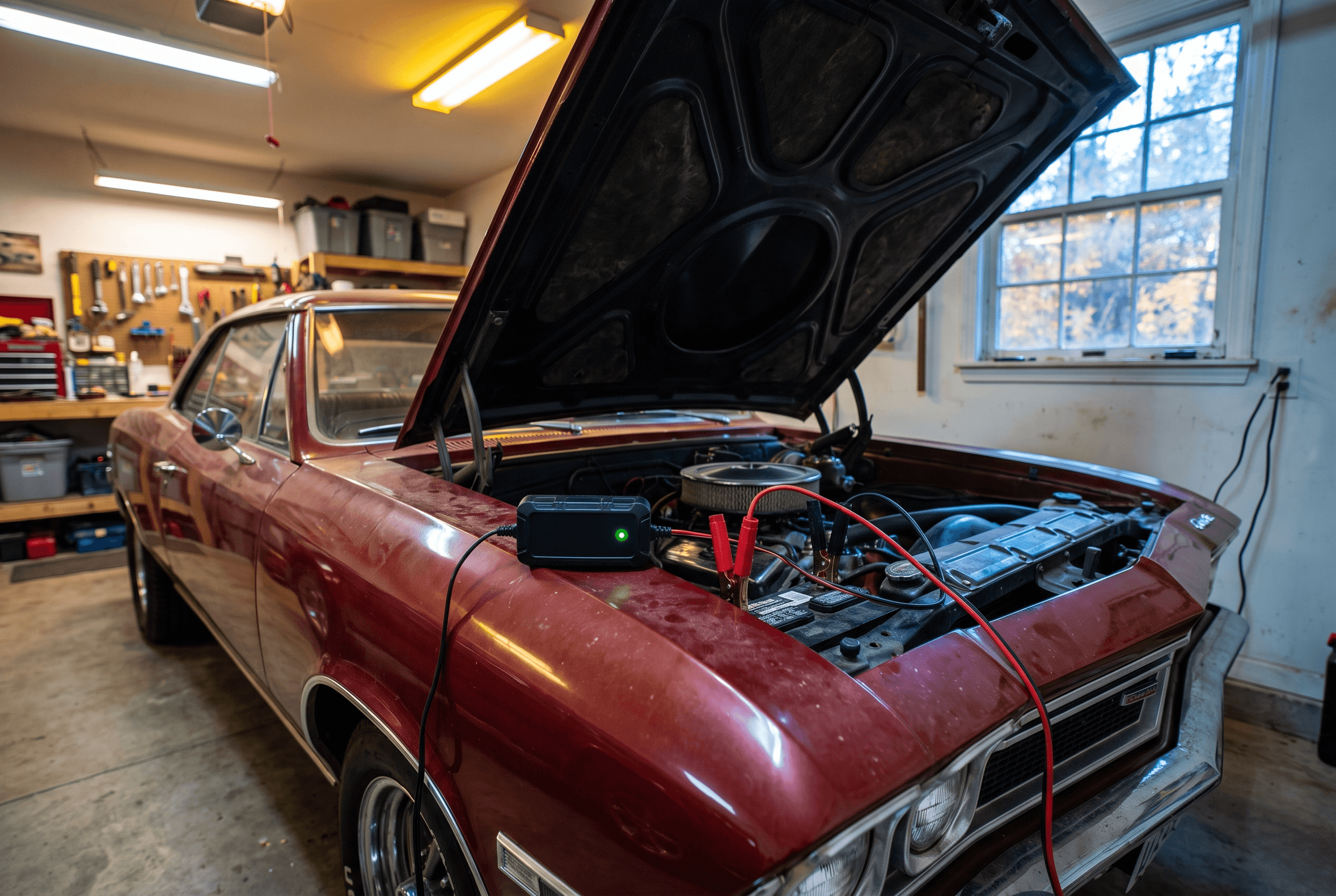
The difference between a battery tender and a trickle charger is what happens after the battery is full. A plain trickle charger pushes a small, fixed current into the battery for as long as it is plugged in, whether the battery needs it or not. A smart maintainer (Battery Tender is one brand name, which is why the two terms get mixed up) watches the battery's voltage, charges it up, then drops to a low float level and only tops up when the voltage sags. For a classic that sits for four or five months, that difference decides whether the battery comes out in spring ready to crank or boiled half dry.
So the short answer: for long, unattended storage, use a smart maintainer. A true trickle charger is fine for a supervised overnight top-up, and nothing more. The rest of this guide explains why, how to tell which one you already own, how to hook it up safely on cars with odd batteries or odd grounds, and when simply disconnecting the battery is the better answer. If you are working through the full storage list, our guide to winterizing a classic car covers fuel, tires and pests; this one stays on the battery.
Why a Stored Battery Dies Anyway
A lead-acid battery loses charge even with nothing connected. Battery University puts lead-acid self-discharge at only a few percent per month at room temperature, and notes the rate roughly doubles with every 10°C (18°F) rise. That alone won't kill a healthy battery over one winter. What does the damage is everything else on top of it:
- Parasitic draw. An electric clock, an alarm, an aftermarket radio's memory or a slightly leaky switch all pull current around the clock. A small draw adds up over 150 days.
- Sulfation. A battery left partly discharged grows sulfate crystals on its plates that resist being charged back out. Battery University recommends recharging a stored lead-acid battery once it falls to about 70 percent, roughly 12.4 volts at rest on a 12-volt battery.
- Freezing. A fully charged battery tolerates far colder temperatures than any garage sees. A discharged one has weaker acid that is mostly water, so it freezes much more easily, and a frozen case can crack.
Keeping the battery full solves all three at once. The question is how to keep it full without overdoing it.
What a Trickle Charger Actually Does
A traditional trickle charger is simple: a small transformer and rectifier that deliver a low, constant current, typically somewhere between half an amp and two amps. It has no idea how full the battery is. Once the battery reaches full charge, the current keeps coming, and the battery has nowhere to put it.
That surplus turns into heat and gassing. Battery University describes what follows on a lead-acid battery held at a high charge voltage too long: water loss from the electrolyte and corrosion of the positive plate grids, which permanently costs capacity. It also advises against holding a battery at full topping voltage (about 14.4 volts on a 12-volt battery) for more than around 48 hours before dropping to float. A dumb trickle charger never drops. Over a winter, a flooded battery on one can cook its cells low on water, and a sealed AGM battery, which can't be topped up, is less tolerant still.
The old manual garage chargers with a needle gauge and a 2/10/50-amp switch belong in the same bucket. They are useful for recharging a flat battery while you are standing there. They are not storage tools.
What a Smart Maintainer Does Differently
A smart maintainer charges in stages. Battery Tender's own description lays out the usual pattern: a bulk stage brings the battery up toward its target voltage, an absorption stage tapers the current as it nears full, and a maintenance stage holds it at float and only adds charge when the voltage drops. For a typical flooded 12-volt battery, float sits in the mid-13-volt range, low enough that the battery isn't being forced and high enough to offset self-discharge.
When you shop, look for these features rather than a brand:
- A float or maintenance mode stated plainly on the box or spec sheet. Words like "automatic" or "multi-stage" are a good sign; "trickle" with no mention of float is not.
- The right battery chemistry settings. Many units have separate standard, AGM and lithium modes. Battery Tender is blunt that you should never use a lead-acid charger on a lithium battery, so if the car has a lithium starter battery, the maintainer must have a lithium mode.
- 6-volt support if you need it. More on that below.
- Reverse-polarity and spark protection, so a clip on the wrong post doesn't do damage.
- A modest amp rating. One amp or so is plenty to keep a charged battery full. Higher-amp units mainly shorten the time to recover a deeply discharged battery.
Popular examples include the Battery Tender Plus, rated at 1.25 amps, and NOCO's GENIUS range. Compare current prices yourself; the features above matter more than the label. Searching for a smart battery maintainer rather than a "trickle charger" gets you into the right aisle.
How to Tell Which One You Already Own
Plenty of garages have a charger that predates its owner's interest in the question. Read the label and the manual first. If it lists charging stages, a float or maintenance mode, or has status lights that change from "charging" to "charged" or "maintaining", it is a smart unit. If it has no indicator beyond a power light, or a single amp rating and nothing else, treat it as a trickle charger.
A cheap digital multimeter settles any doubt. Leave the charger on a fully charged battery overnight and measure across the terminals. A smart unit settles back toward float. A charger that keeps the voltage climbing well past the low 14s after the battery is full is not maintaining anything, and it shouldn't be left on unattended.
Hooking It Up Safely
Lead-acid batteries give off hydrogen while charging, so charge in a ventilated space and keep sparks away from the battery. Charger makers' manuals give a consistent order for a battery left in the car:
- Negative-ground cars (most cars, and nearly all American cars from the mid-1950s on): connect the red clip to the battery's positive post first, then the black clip to bare metal on the chassis or engine block, away from the battery. Keep both clips clear of fuel lines, the carburetor and thin sheet-metal body panels.
- Positive-ground cars (many British cars, among others): the roles swap. The black clip goes to the battery's ungrounded negative post, then the red clip to the chassis or block, away from the battery. Check which post runs to the body before you clip anything.
- Unplug the charger from the wall before removing the clips, and remove them in reverse order.
For a car that goes on the maintainer every winter, a ring-terminal quick-disconnect harness makes this much easier. The short pigtail bolts to the battery terminals and stays there; the maintainer plugs into it in seconds, with no clips to slip off. Route the plug where you can reach it without disturbing anything, such as just inside the grille or behind a kick panel, and cap it when not in use.
Battery in the trunk? Some cars came that way and plenty of restomods relocate it. If the car has remote charging posts under the hood, use them as its manual describes. Otherwise a harness run to the trunk opening works, as long as the lead doesn't get pinched by the lid or crushed into the weatherstrip. A flooded battery inside a trunk or cabin should sit in a sealed, vented box, because the hydrogen it gives off while charging has to go somewhere.
6-Volt and Positive-Ground Cars
Many American cars built before the mid-1950s run 6-volt systems, and a 12-volt-only maintainer will overcharge a 6-volt battery. You need a charger with a 6-volt setting. Battery Tender sells a 6V/12V selectable 1.25-amp unit, and NOCO's GENIUS1 and GENIUS5 both list 6-volt modes. A 6V/12V battery maintainer is a one-time purchase that covers a flathead Ford and a later daily driver alike.
Positive ground doesn't change the maintainer you buy, only how you connect it, as above. The maintainer is connected only to the battery and the chassis, so it doesn't care which way the car is grounded as long as the clips are on the right points. A quick-disconnect harness bolted straight to both battery posts takes the chassis out of the question entirely. Positive ground does matter for anything else electrical you add; our guide to hidden audio upgrades for classic cars covers that side of it.
When Disconnecting Is the Simpler Answer
A maintainer isn't the only reasonable choice. Disconnecting the battery stops parasitic draw completely, needs no outlet near the car, and costs nothing. It makes sense when:
- The car is stored somewhere with no power, such as a storage unit or a barn.
- You'll visit regularly and can check voltage with a meter every few weeks.
- The car has a known draw you haven't tracked down yet.
Pull the negative cable, or fit a battery disconnect switch on the negative post so it's a quarter turn instead of a wrench job. Remember that disconnecting stops the draw but not self-discharge, so check the battery with a meter partway through the winter and recharge it if it drops toward 12.4 volts. For the longest storage, or an unheated building in a hard-freeze region, take the battery out, keep it somewhere it won't freeze, and put it on a maintainer there.
The trade-offs are small but real: the clock stops, a radio loses its presets, and some aftermarket electronics may need resetting. Check the manuals for anything with memory before you disconnect it.
Spring Check Before the First Crank
Whichever route you took, look before you crank. On a flooded battery, check the electrolyte level and top up with distilled water only if the plates are exposed. Clean any white or green corrosion off the terminals. A healthy, fully charged 12-volt battery resting off the charger reads in the mid-12-volt range; one that won't hold charge after a full cycle on the maintainer has likely reached the end of its life, and spring is a far better time to find that out than in a show-field parking lot. Then pick your first shows of the season.
Frequently Asked Questions
Can I leave a battery tender on all winter?
Yes, if it is a smart maintainer with a float or maintenance mode. That is what they are built for. Check on it every few weeks, and check the water level in a flooded battery a couple of times over the winter.
Will a trickle charger overcharge my battery?
A traditional trickle charger with no automatic shutoff or float stage can, if it's left on for weeks. It keeps pushing current into a full battery, which causes gassing, water loss and plate corrosion. Use it for supervised top-ups only.
Should I disconnect the battery if I'm using a maintainer?
No. A maintainer connected to the battery keeps it full despite small parasitic draws. Disconnect instead of using a maintainer when there's no power at the storage location, or when you have a draw large enough to worry about.
Can I use a 12-volt battery tender on a 6-volt car?
No. A 12-volt charger will overcharge a 6-volt battery. Use a maintainer with a selectable 6-volt mode, and confirm the setting before you plug it in.
Keep Reading
Find Your Next Car Show
Browse hundreds of upcoming shows, cruise-ins, and meets near you.
Browse Events