
How to Plan a Classic Car Restoration Project: Budget, Timeline, and Where to Start
Most stalled projects were not underfunded, they were unplanned. Here is the order to work in: finish standard, finished value, written inventory, itemized quotes, phased work, and a contingency that survives the day the body comes off.
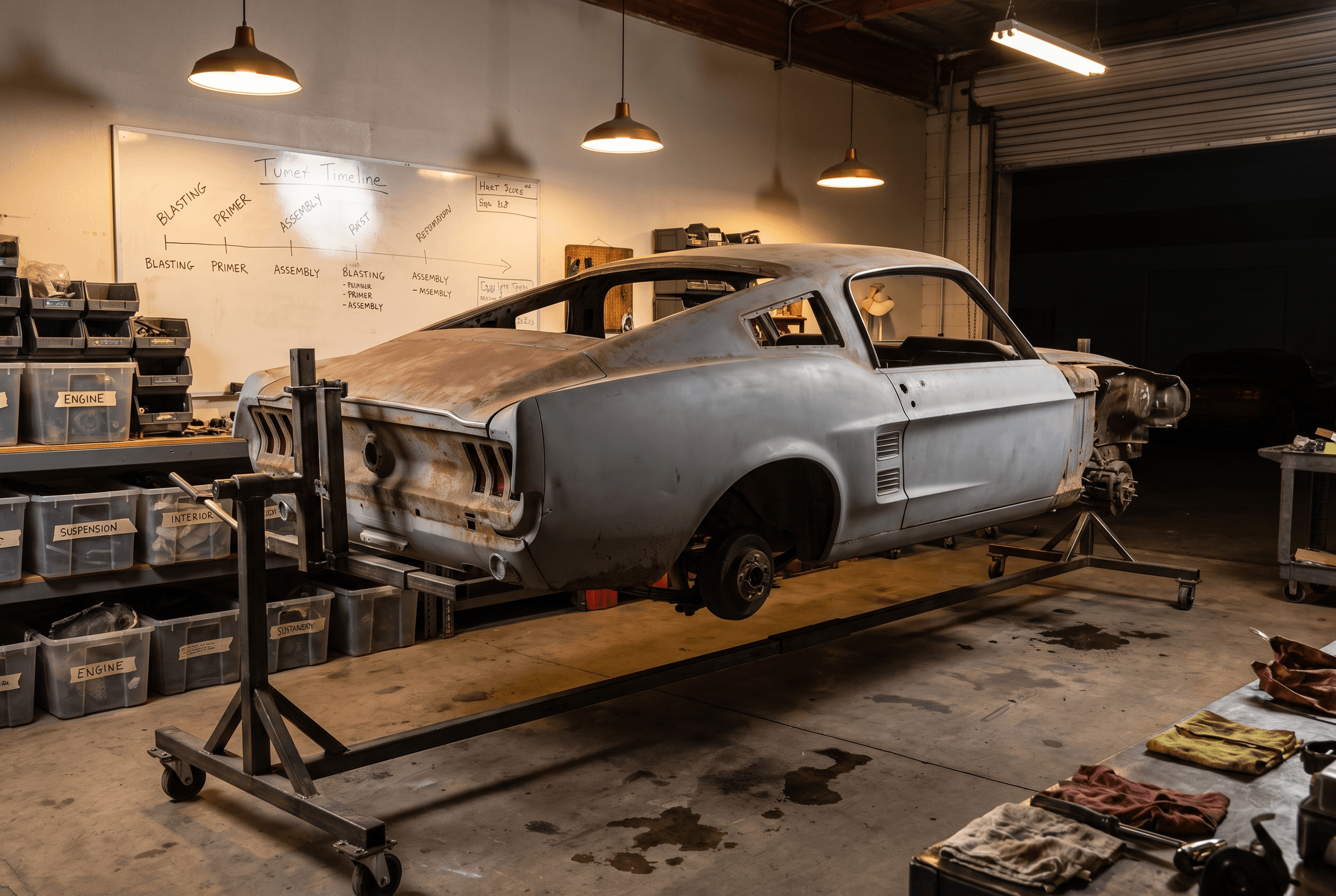
Plan a restoration in this order and you will spend less money than someone who starts by buying parts: decide the finish standard you actually want, find out what the car is worth once it is finished, write a full condition inventory before anything comes apart, get itemized quotes for the four cost centers (metal, paint, mechanical, interior), sequence the work so nothing gets done twice, and add 10 to 20 percent contingency on top of the total. Everything after that is execution.
One number governs the whole exercise. Hagerty puts the average hourly labor charge for this kind of work at "upwards of $70 per hour," higher for specialized services, and points out that every stage of a restoration takes hours, often hundreds of hours, of manual labor. Parts you can shop around for. Labor is the bill. So plan the project in hours first and dollars second, because that is the direction the real cost runs.
1. Decide the Finish Standard Before You Price Anything
"Restored" is not a specification. The standard you are aiming at is the single biggest multiplier on the budget, and the collector-car world already has a shared vocabulary for it. Hagerty's four condition grades are the practical one:
- #1 Concours — the best in the world. Mirror-like paint and chrome, correct materials superbly fitted, groomed down to the tire treads, and barely driven. Hagerty notes these are extremely rare in the wild, because exposure alone degrades the finish out of the grade.
- #2 Excellent — wins a local or regional show. A seasoned observer has to look closely to find flaws, and it drives like a new car of its era.
- #3 Good — runs and drives well, may carry some incorrect parts, ready for a long tour without excuses, and no casual passerby spots a flaw.
- #4 Fair — which is also what a deteriorated older restoration becomes.
Most people describing their dream car are describing a #2 and budgeting for a #3. Pick one, write it at the top of the project file, and test every later decision against it: a #3 driver does not need show chrome, a concealed harness, or a bare-metal respray, and a #2 needs all three. The gap between those two cars is frequently the price of a second car.
2. Find Out What the Finished Car Is Worth
Look up your exact year, make, model and trim at the grade you just picked. Hagerty's Valuation Tools are free and priced by those same four grades, which is why the grade comes first. Then read Hagerty's own verdict: after a major restoration, unless the car is extremely rare, high-value or famous, "it's highly unlikely that you will recoup the costs," and comparing the finished value against your estimate, "you'll probably find that just the paint job or the engine rebuild is more than the overall value."
That is not a reason to skip the project. It is a reason to name the number you are willing to be down at the end, before you are down it. If the answer is "nothing," you want a finished car, which is where our guide to the best time to buy a classic car lands from the buying side.
3. Inventory the Car Before You Touch a Bolt
Put the car on stands, get underneath with a bright light and a small hammer, and write a panel-by-panel list: floors, rockers, frame rails, shock towers, trunk pan, lower quarters, cowl, door bottoms. Tap suspected rust rather than poking it and flag anything that sounds dull instead of sharp. Photograph everything, including what looks fine, because in eighteen months you will not remember how a bracket was oriented.
Where the car spent its life predicts the metalwork better than the odometer does. A car that lived through Midwest winters carries salt damage in seams you cannot see from below, which is why the same model out of Michigan and out of Arizona are two different projects at one asking price, and the gap shows up in hours of fabrication rather than in the parts bill.
Two cheap habits make disassembly recoverable: soak every fastener with penetrating oil a day ahead instead of twisting studs off dry, and bag hardware per assembly in labeled resealable parts bags. A coffee can of unsorted bolts costs real money, because the replacement for a correct original fastener is often a special-order part.
4. Price the Four Cost Centers Separately
Get an itemized quote for each, not one lump sum. A single number hides which stage is consuming the budget and makes dropping a scope item mid-project impossible to price.
- Metal and strip. Media blasting is quoted by the piece and published price lists exist. One blasting shop's current list runs $950 to $1,300 for a full shell inside, outside and underneath, $500 for a frame, $185 a hood, $140 a door, $120 a fender or trunk lid, plus $250 for rotisserie setup and 35 percent over the blast cost for zinc coating. Fabrication afterwards is hours, not a catalog item.
- Paint and body. This is usually the largest single line. Hagerty describes several hundred hours of body prep and paint as perfectly normal on a higher-quality restoration, and cites one local shop whose published packages tier at roughly $13K for daily-driver paint, $25K for show-level, $35K for award-winning and $55K-plus for best-of-show work. At the other end, Hagerty priced a chain shop's top-tier package at $1,499 for a small, straight, rust-free car, with far less of the prep that a restoration needs. A scruffy but sound Chevy C10 drew an estimate of nearly $20,000 for paint and body in the same article.
- Mechanical. Engine, transmission, rear end, brakes, fuel and cooling. Machine shop work is quoted per operation, so ask for the sheet, and decide early whether you are rebuilding the numbers-matching engine.
- Interior, glass and brightwork. Rechroming is the sleeper cost here, because plating shops charge separately for the straightening and polishing that comes before the plating.
Ask every shop for its hourly rate in writing, then do Hagerty's arithmetic on it: going from $70 to $80 an hour on a modest 500-hour job is $5,000 extra. That cuts both ways. The cheaper shop is only cheaper if it takes the same number of hours, and on bodywork it usually does not.
5. Sequence the Work So Nothing Gets Done Twice
The order below keeps a finished surface from being handled twice. Deviating from it is how a fresh quarter panel picks up a scratch during driveline installation.
- Teardown and strip — document, bag, label, then blast or chemically strip the shell.
- Structural metal — frame, floors, rockers, towers. Everything that carries load, before anything cosmetic.
- Panel fit and mock-up — hang the doors, hood, deck lid, bumpers, glass and trim on the car in primer and set every gap now. Gaps adjusted after paint mean touching painted edges. This dry fit is the step first-timers skip and professionals never do.
- Body prep and paint — block sanding through the grits is where the hours actually go.
- Drivetrain — which runs in parallel at a machine shop while the body is in the booth. An engine stand in a spare corner of the garage buys months of calendar time.
- Suspension, brakes, fuel, wiring — into a painted shell, and the last comfortable moment to reach under the dash.
- Interior, then final trim and glass.
- Sorting — leaks, idle, alignment, brake bleed, and the hundred adjustments that turn an assembled car into a driving one. Budget real weeks for it.
If you intend to weld patch panels yourself, a 110V MIG welder handles sheet metal of this gauge, but practise on scrap of the same thickness first. Burning through a floor pan is a Saturday; burning through a quarter panel is a new quarter panel.
6. Build a Budget That Survives Teardown
Budget by phase, fund each phase before it starts, and keep a spreadsheet with a row per invoice. Three rules hold up:
- Carry 10 to 20 percent contingency and do not spend it on scope you merely want. It exists for the frame damage found under the body and the rust found under the interior, both of which Hagerty lists as routine post-teardown discoveries.
- Do not stockpile parts. Buy for the phase you are on. Hagerty's warning is specific: buy too far ahead and you will forget what is on the shelf and buy it twice. Return windows expire too.
- Pay in progress payments against milestones, not a large deposit up front, and get the scope, hourly rate and who owns removed original parts in writing before the car is dropped off.
- Keep every receipt and a dated photo log in one place. That file is documentation at judging, evidence for an agreed-value policy, and a large part of what the car brings if it is ever sold.
7. How Long It Actually Takes
Do the hours math instead of guessing at months. A shop quoting 400 hours for a driver-level job, with one technician on your car ten hours a week, is roughly forty working weeks before any parts delay, and shops rarely keep one person on one car continuously. Hagerty's framing is blunt: "This will take weeks and months, not days."
Three things stretch the calendar more than the work does: shop queue time, because good shops are booked out and your car may sit before it is started; parts backorder, which on a low-volume model can mean months waiting on one bracket; and your own availability if this is a DIY build fitted around a job. "One winter" is realistic for a mechanical refresh and a punch list, the work covered in our guide to off-season garage projects. It is not realistic for a body-off restoration, and treating it as if it were is how a car sits in primer for three years.
8. Insurance, Storage and Paperwork While It Is Apart
A car in pieces is worth less than the money you have put into it, and a standard policy on a non-running project will not reflect the build. Specialist insurers write for this: Hagerty's Vehicle Under Construction endorsement raises the Guaranteed Value 10 percent per quarter during the policy period, up to a $25,000 total increase, and adds $750 of automotive tools coverage. The catch is in their own fine print, that the increases reset at renewal unless you ask for the value to be carried forward. Terms and availability differ by insurer and state, so confirm the current wording rather than relying on this summary.
Titling and registration deserve a call before, not after. Non-operational status, VIN inspections following body or frame work, historic plates, and what a state wants when a car has been off the road for years are set at state level and they change, so check your own state's current DMV requirements rather than a forum. If a replacement frame, body shell or reconstructed title is involved, get that answer in writing before the car comes apart.
Frequently Asked Questions
How much does it cost to restore a classic car?
There is no single figure, because the finish standard and the car's starting condition move the total by multiples. Build the number from itemized quotes for strip and metal, body and paint, mechanical, and interior, and assume labor dominates: Hagerty puts the average restoration labor rate at upwards of $70 an hour, with body prep and paint alone frequently running several hundred hours. Then add 10 to 20 percent for what teardown reveals.
Is it cheaper to restore a car or buy one already restored?
Buying finished is almost always cheaper. Hagerty's position is that you are unlikely to recoup restoration costs unless the car is rare or historically significant, and that the paint job or engine rebuild alone can exceed the finished value. Restore for the process and the control over the result, not to acquire the car for less.
How long does a classic car restoration take?
Convert the quoted hours into calendar time rather than accepting a figure in months. Four hundred shop hours at ten hours a week is about forty weeks, with queue time and parts backorders on top. A body-off restoration commonly runs multiple years, and a shop promising a fast turnaround on one is describing a price, not a schedule.
What parts of a restoration should I do myself to save money?
Disassembly and stripping, which is Hagerty's own recommendation: taking a car apart is far easier than building it up, and grinding old paint off is the clearest way to keep hours off a professional invoice. Document obsessively while you do it. Paint, structural welding and machine work are where inexperience gets expensive to undo.
Start With the Finish Line
The cars that get finished belong to owners who could answer, on day one, what standard they were building to and what they were willing to spend getting there. Write those two things down before the first bolt comes out and the rest of the plan largely writes itself. Then see what is showing near you this weekend and pick the first show worth aiming at, because a date on the calendar finishes more projects than a spreadsheet ever will.
Keep Reading
Find Your Next Car Show
Browse hundreds of upcoming shows, cruise-ins, and meets near you.
Browse Events