
Buying a Classic Car in Winter: The Cold-Weather Inspection Checklist
Winter buying season means better prices and a colder set of clues. Here's how to inspect a classic car for what only cold weather actually reveals.
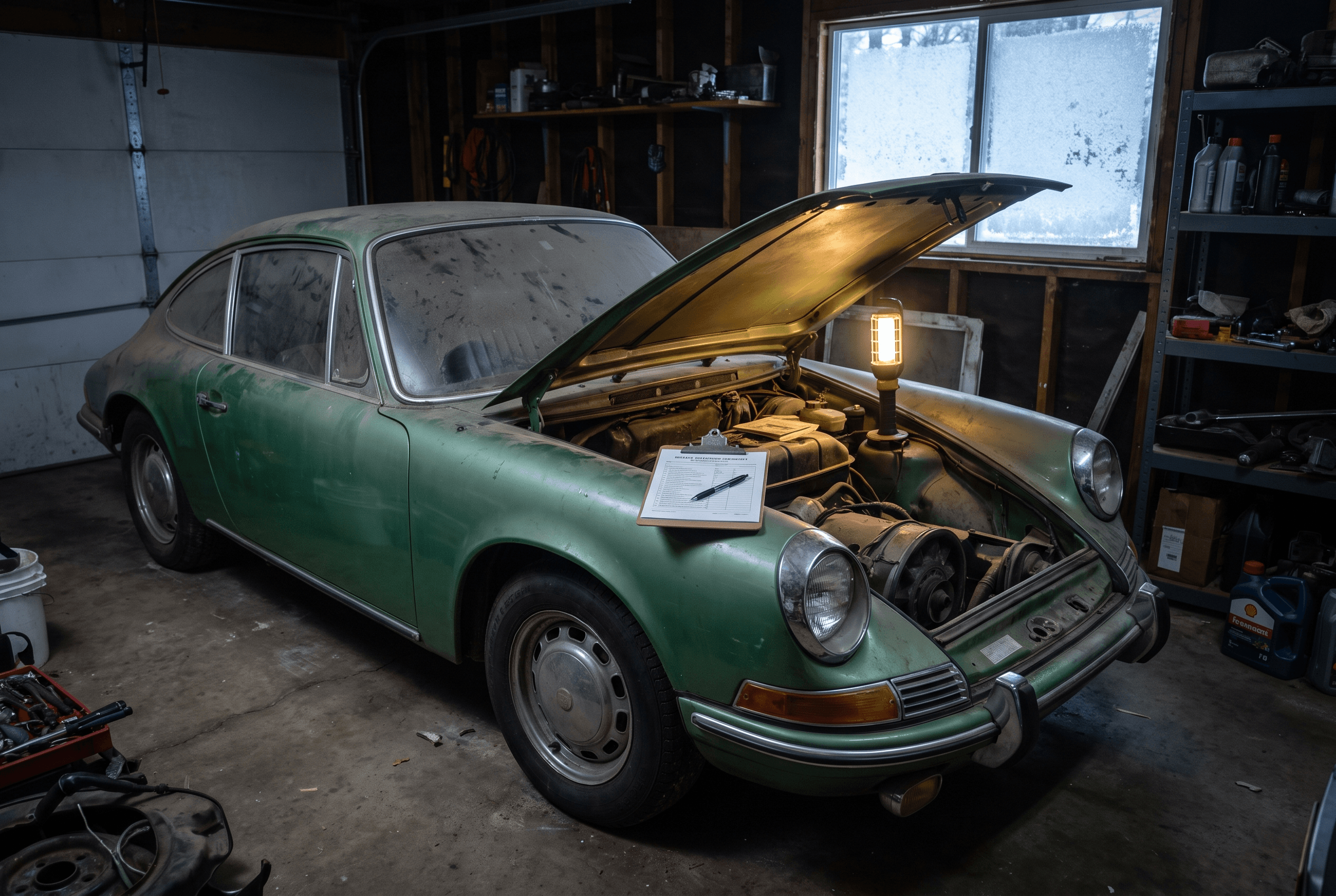
Shopping for a classic car in January or February is usually the smart financial move: sellers are more motivated, prices soften, and you're not bidding against the summer crowd. But a winter purchase strips away the easiest diagnostic tool you have, a real road test on dry pavement, and swaps in cold-weather symptoms that can either hide problems or expose them, depending on what you know to look for.
This is a hands-on inspection checklist for buying in the cold months: what a cold start actually tells you, how to check a battery and charging system that's already working harder than usual, where rust hides under sealer and undercoating a summer buyer would never think to check, and how to read fluids and behavior that change with the temperature. It's a companion to our guide on the best time of year to buy a classic car, which covers pricing and timing. This one is about technique once you're standing in front of the car.
Why a Winter Inspection Isn't Just a Summer Inspection in a Coat
Three things change once the temperature drops. You often can't do a real road test, salted roads are a legitimate reason for a seller to say no to 20 miles at speed. Cold makes some problems worse and easier to catch: a weak battery, a marginal starter, a slipping clutch on cold-thick fluid. And cold hides other problems summer would reveal, a coolant leak that only weeps once the block is fully hot, or a soft top that only shows its cracks in warm, flexible weather. Know which category each check falls into before you rely on it.
The Cold Start Tells You More Than You Think
Ask the seller not to start the car before you arrive, and specifically not to have it "already warmed up" when you pull up. A cold start is one of the most honest diagnostic moments you'll get on a used classic, and a seller who's pre-started it has taken that test away from you on purpose.
Count the seconds of cranking before it catches. A healthy engine with decent compression and a sound charging system should fire within a few seconds; longer than that on a cold morning points to weak compression, a fuel delivery issue, or ignition trouble a warm engine would mask. Once running, listen for a rattle in the first 10-15 seconds that clears as oil pressure builds, normal in small amounts, worth asking about if it's loud or lingers. Watch the exhaust: white smoke that clears within a minute or two is just condensation burning off, completely normal in cold weather. White smoke that doesn't clear or smells sweet is coolant burning, a head gasket or cracked head. Blue smoke at any point is oil.
Battery and Charging System: Cold Is a Free Stress Test
Cold weather cuts a battery's usable cranking power roughly in half by 0°F compared to a warm morning, right as thickened oil makes the engine harder to turn over. A marginal battery that limps through a July start can fail outright at 20 degrees, which is exactly the stress test you want during an inspection. If a battery tender is already hooked up when you arrive, ask how long it's been connected, needing help holding a charge in mild weather is telling you something.
Once it's running, check charging voltage with a multimeter across the battery terminals, roughly 13.8-14.4 volts at idle on a healthy alternator or generator. Anything close to 12 volts running means the charging system isn't doing its job, and you'll be back to a dead battery within days of owning it. A compact automotive multimeter is worth the glovebox space for this check and every one after it.
Hunting for Rust You Can't See in Summer
Undercoating and sealer applied ahead of a sale hide rust year-round, but winter gives you two extra tells. Fresh undercoating sprayed over active rust often looks slightly duller or less uniform in cold light than factory or professionally redone coating, run a gloved hand along seams and edges where a transition is easiest to feel. And if the car has actually been driven on salted roads this season, check for salt residue or white bloom in the wheel wells and rocker seams, its presence tells you how the car has really been used, not just what the seller says. In heavy road-salt regions like Michigan or the broader Northeast and upper Midwest, weight that check even more heavily.
For the physical check, bring a flathead screwdriver or awl and press firmly, not violently, on frame rails, rocker panels, floor pan edges, and subframe mounts. Sound metal resists. If the tool sinks in, punches through, or the surface caves like a stale cracker, that section has lost structural integrity and needs professional evaluation, this isn't a cosmetic issue on a frame rail or rocker. Rockers tie the front and rear structure together and factor into side-impact protection on later classics, so treat softness there as a safety question first. Rust that far gone isn't automatically fatal if you can fabricate: the Feature Ready 1966 Mustang we spotlighted needed its rain gutters made from scratch.
Finding Filler: The Poke Test's Companion Tool
The screwdriver test finds soft metal; it won't tell you how much bodywork hides under paint that feels solid. A magnet dragged along panels used to be the standard trick, but it only works on steel, does nothing on the aluminum and plastic panels increasingly common even on later classics, and only tells you filler is present, not how much. A paint thickness gauge solves both problems: factory paint reads in a fairly tight, consistent range, and a reading that jumps noticeably on one panel, especially a quarter panel, fender, or door skin, means filler or a repaint there. It won't tell you why the repair happened, a small parking-lot dent fixed properly is nothing to worry about, but it turns a guess into a number you can ask the seller about directly.
Fluids and Feel: What the Cold Reveals
Check the oil on the dipstick before the car has been driven that day. Oil that's milky, foamy, or coffee-with-cream colored points to a coolant leak into the crankcase, a head gasket issue that's often easier to spot when the oil hasn't been driven hot and remixed. Check the coolant reservoir and radiator cap area for the same milky residue or an oily sheen.
A clutch or manual transmission that feels stiffer or grabbier on a cold start but smooths out once everything warms up is normal to a point, gear oil thickens in the cold, but a pedal that stays grabby even warm is worth flagging. Power steering that whines on a cold start but smooths out after driving is typically fine; a whine that never goes away points to a pump or fluid issue regardless of temperature.
Working Around the Road Test You Can't Fully Do
If salted roads take a real road test off the table, negotiate a shorter, lower-speed test in a clean lot or on a road you know hasn't been treated, enough to feel the clutch engagement point, listen for driveline noise, and check that the brakes pull evenly. Ask directly whether the car has been driven on salted roads this season and how long it typically sat before being rinsed, salt left in a wheel well for a week does more damage than salt rinsed off the same day. If the seller won't allow any test drive at all, treated roads or not, that's the hobby's most reliable red flag in any season.
Budgeting for a Professional Winter Inspection
A general pre-purchase inspection typically runs $150-$250, but a marque specialist doing a full classic-specific inspection, engine, frame, electrical, and a cold-weather assessment, more commonly runs $300-$600, and higher for a concours-level or exotic classic. That's real money, but it's a rounding error against a five-figure mistake, and in winter it buys you someone who knows what a cold engine and a stiff clutch are supposed to feel like versus what they're not. If a seller balks at a specialist inspection timed around a cold morning specifically, treat that resistance as information.
A Note on Titles, Registration, and State Rules
Salvage title status, emissions exemptions for older vehicles, and the registration and titling process all vary by state and change over time; some states also handle seasonal registration for collector plates differently. Confirm your state's current rules before you commit, particularly if you're buying across state lines, this article isn't a substitute for checking with your state's DMV or equivalent agency.
Frequently Asked Questions
Is it a bad idea to buy a classic car in winter without a test drive?
It's not ideal, but manageable if you compensate with a longer static inspection: a cold start, a charging system check, a rust and filler check, and a short, low-speed test in a safe area if the seller allows it. Walking away from a seller who refuses any test drive at all is still the right call.
How cold is too cold to properly test-start a classic car for inspection?
There's no hard cutoff, most classics can be cold-started safely well into the 20s and 30s°F. What matters is that the car hasn't been pre-warmed by the seller before you arrive, that's the condition that actually gives you useful information.
Does a weak battery in winter always mean a bad battery?
No. Cold alone can make a genuinely healthy battery struggle, especially one nearing the end of a normal 3-5 year lifespan. Check the charging voltage once it's running; a battery that struggles to start but charges normally afterward may just need a load test rather than being an automatic red flag on the car.
Should I have the car inspected before or after negotiating price?
Before. Use the findings, rust severity, filler locations, charging system health, as concrete negotiating points rather than negotiating blind and hoping the inspection comes back clean. A specific number tied to a specific finding beats a general "it needs work."
Can I trust a seller's claim that the car "always starts fine" in winter?
Verify it yourself with a genuinely cold start rather than taking the claim at face value. Sellers aren't necessarily being dishonest, a car parked in a heated garage starts differently than the same car parked outside, so the claim may be true under different conditions than the ones you'll actually store it in.
Buy It Right, Then Show It
A winter purchase can be one of the best-value windows in the hobby if you inspect for what the cold actually reveals instead of just working around it. Once it's yours, our winterizing guide is worth a read even mid-season, plenty of the battery and moisture-control advice applies to a car you're storing partway through winter, not just one going in fresh. When it's ready to come out, browse upcoming car shows or check what's happening near you this weekend to plan its first outing.
Keep Reading
Find Your Next Car Show
Browse hundreds of upcoming shows, cruise-ins, and meets near you.
Browse Events