
How to Organize a Car Show: A Planning Guide for First-Time Organizers
Your first show is mostly logistics in a specific order: a date nobody else wants, a lot big enough for the field, the insurance certificate the venue will demand, and volunteers who know where to park 100 cars.
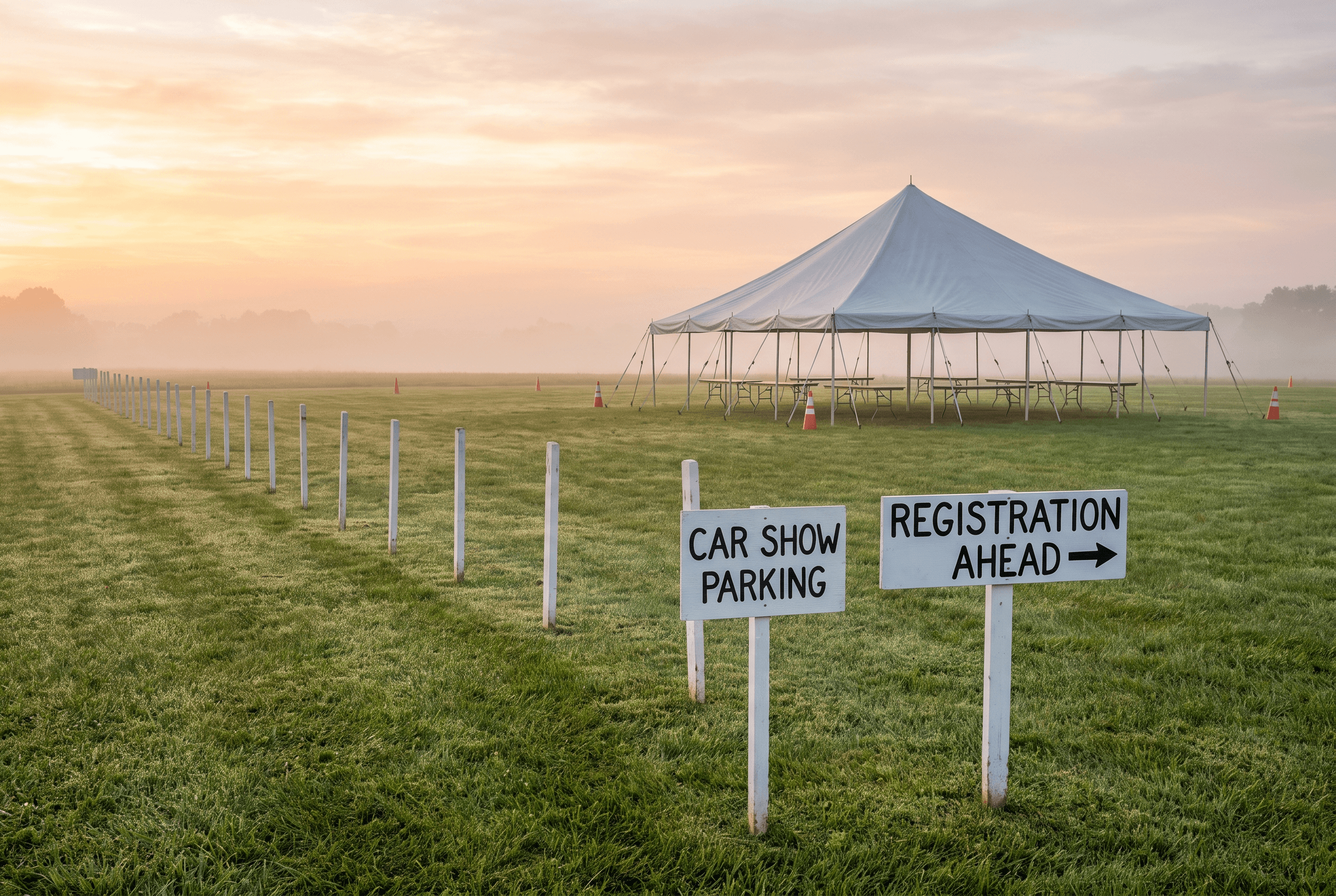
Organizing a car show is mostly logistics, in a specific order: pick a date the local calendar isn't already using, secure a venue with enough hard surface for the field, check whether your city requires a special event permit and how early it wants the application, buy the liability policy the venue will demand in writing, publish your classes and registration terms before you promote, then recruit volunteers to park cars and run a registration table. Trophies — the part most first-timers start with — are a line item you order six weeks out.
For a first-year local show of 75 to 150 cars, start four to six months ahead. That lead time is set by permit windows, not by your own pace. Seattle asks for special event applications at least 90 days before the event date and warns that anything filed inside 45 days may be rejected for insufficient processing time; Berkeley's threshold is 30 days under 500 attendees, 60 days for larger events or major street closures. Those are two cities' rules, not a national standard — every jurisdiction writes its own, so your first call is to your city or county special events office.
1. Pick the Date Before You Pick Anything Else
The date is the biggest free lever you have on attendance.
- Check what already exists that weekend. A regional show draws from the same 60-mile pool you do. Scan your metro's calendar — the Dallas-Fort Worth calendar shows how dense a big market gets at peak season — and check the weekends either side of your target.
- Don't fight the local anchor event. Going head-to-head with a show that has run for twenty years costs you entries and earns you a reputation with organizers whose help you'll want later.
- Decide the rain policy now and print it on the registration form: rain date, rain-or-shine, or refunds. Deciding it at 6 a.m. on show day with forty pre-registered entrants waiting is how goodwill gets spent.
- Mind the asphalt. A blacktop lot in July punishes owners sitting beside their cars for six hours and keeps spectators home. Late spring and September through October are the comfortable windows across most of the country.
2. Size the Venue in Stalls, Not in Ambition
A standard US commercial parking stall is about 9 feet wide by 18 feet long, with drive aisles around 14 feet one-way and 24 feet two-way. Show cars need more: owners open doors, prop hoods and trunks and set out chairs, and spectators pass between cars. The rule that works is two standard stalls per show car, or a marked space roughly 10 by 20 feet with a walking gap between rows. A 200-space lot is a 100-car show.
Settle these with the property owner in writing: surface and drainage (dry grass under a hot exhaust or catalytic converter is a real fire risk — on turf, keep extinguishers at the field corners and brief marshals on them); the sprinkler schedule and who can override the timer, because an irrigation zone firing at 6 a.m. across your marked-out field is a classic first-year loss; working exterior power for the PA and vendors, or a generator; gate keys, since entrants arrive an hour before you told them to; and accessible parking with a firm path to registration and restrooms.
Then sketch the layout on the lot's own aerial photo: one entrance for entrants, a separate spectator lot, a registration table positioned before the field so no unregistered car reaches a spot, one-way flow, and a fire lane kept clear all day. Decide whether you park by class — easier for judges, slower at the gate — or by arrival, which stages fast but makes judges walk the field for one class.
3. Permits, Insurance, and the Certificate the Venue Will Demand
Whether you need a permit depends on where you are and what you're doing. A show in a private business's lot with no street closure often needs nothing but the owner's blessing; the same show in a public park, or with a lane closed, almost always needs a city permit with its own deadline and fee. Three related approvals catch people out: food vendors usually need their own health department permits, amplified sound may fall under a noise ordinance, and raffles are regulated gambling in many states — a 50/50 draw that's routine in one state needs a license or is barred in another.
Insurance is the near-universal requirement, because venues impose it even where cities don't. You're buying a single-day special event general liability policy. Insureon reports its small-business customers pay an average of $278 for one-day special event coverage, typically $250-$285, with $1 million per occurrence and a $2 million aggregate the most popular structure. Buy it after you know what the venue and city require: Berkeley, for one, requires proof of $2,000,000 in general liability with the city named as an additional insured. That additional-insured wording is what first-timers miss — a certificate in your club's name alone gets rejected, and re-issuing one a week out is a stressful errand.
Permit deadlines, vendor rules, raffle legality and insurance minimums are state and local questions, and they change. Treat the figures above as the shape of the requirement, not the rule where you live.
4. Decide How You'll Judge — Then Publish the Rules
Three formats work. People's choice is ballots handed to attendees: nearly free, no judges, rewards charm over technical work. Judged classes produce results entrants respect, at the cost of recruiting and feeding judges. The hybrid — judged classes plus a people's choice and a Best of Show — is what most successful local shows run.
If you judge, design fewer and fuller classes. Fifteen classes across a 60-car field produces classes with one entrant, and a trophy nobody competed for means nothing to the person holding it. Start with broad splits (era, domestic/import, modified/stock, trucks, motorcycles) and subdivide only after two consecutive years fill a class. Publish the class list and score sheet categories with the registration form so nobody enters a tastefully modified car in a stock-original class; a workable local sheet covers exterior and paint, interior, engine bay, and overall presentation.
Recruit judges from outside the host club if you can, or at minimum bar club members' cars from classes their own members judge — the perception that the host club wins everything is what stops a second year from happening. Time the judging before you set the awards slot: walk one car yourself with the score sheet, then multiply by field size divided by your number of judging teams. Trophy suppliers sell small-show packages starting around $225 with extra trophies in the $15 range, so order against a realistic count with a modest buffer; dash plaques for the first 50 or 100 registrants are the traditional cheap souvenir.
5. Registration and the Money Table
Run both pre-registration and day-of. Pre-registration tells you how many trophies and porta-potties to order; day-of is where a surprising share of the field comes from. Local judged shows typically land between $15 and $40 — our breakdown of what car show entry fees actually cover is a sanity check on what entrants expect for the price — and pricing pre-registration a few dollars under day-of is the standard nudge toward the number you need early.
Eventbrite charges nothing for free events; paid tickets carry a 3.7% + $1.79 service fee per ticket plus a 2.9% payment processing fee per order, and you choose whether entrants pay those or you absorb them. A form plus Venmo or PayPal costs less and creates more manual reconciliation — fine at 60 cars, painful at 300. The day-of table needs two people, a cash box with plenty of $5 bills, numbered windshield cards, printed forms carrying a liability waiver and photo-release line, and the class list posted where entrants can read it. Publish a hard cap if your lot has one and mean it: turning cars away is unpleasant, and parking cars into the fire lane is worse.
6. What a 100-Car Show Actually Costs
- Special event liability insurance: roughly $250-$285 for a single day at $1M/$2M limits
- Restrooms: basic portable units run about $98-$188 per day each. Rental companies plan one unit per 50-75 guests for a short event and one per 50 past four hours, plus 15-20% more if alcohol is served. Ask specifically for an accessible unit and a handwashing station
- Awards: packages from around $225, extra trophies near $15 each, plus dash plaques
- Site and signage: venue fee or donation, permit fee where required, a road-frontage banner, directional signs, flyers
- Equipment: orange traffic cones for lane and fire-lane marking, two-way radios so marshals and registration aren't shouting across a lot, a 10x10 pop-up canopy over the registration table, trash barrels, a first-aid kit, and a PA or megaphone for awards
Revenue comes from entry fees, an optional spectator gate, vendor spaces, sponsor banners from local shops — which often start as in-kind door prizes rather than cash — and a 50/50 raffle where your state allows it. A first-year show that breaks even is a success; the surplus arrives in year two, once the date is known and sponsors have seen the field. Raising money for a charity? Publish the split up front and the total afterwards, because shows that post last year's number are the ones entrants trust.
7. Volunteers and the Day-Of Run Sheet
Parking is the bottleneck, and most other show-day problems are downstream of it. For a 100-car field, plan on eight to twelve people: three or four parking marshals at peak arrival, two on registration, one judging coordinator to shepherd judges and collect sheets, one announcer, one vendor liaison, and one or two on trash and teardown. This is exactly the job a club's core group exists for. A run sheet for a 10 a.m. to 3 p.m. judged show:
- 6:30 a.m. — setup crew on site: cones out, rows marked, canopy up, signs at the road
- 8:00 a.m. — gates open to entrants, registration live, marshals staging cars
- 10:00 a.m. — spectator gate opens, field closes to arriving show cars. Publish this time; it's the one entrants most often miss
- 10:30 a.m.-1:00 p.m. — judging window, entrants with their cars, hoods open per the show's norms
- 1:00-1:45 p.m. — sheets to the coordinator, tallying somewhere quiet, ballots counted
- 2:00 p.m. — awards; read the class name before the winner so the crowd can follow
- 2:45 p.m. — controlled exit, one row at a time. A burnout leaving undoes a show faster than anything else, and the venue remembers
- 3:30 p.m. — teardown, trash, and a walk of the lot with the venue contact
Give every volunteer one printed page: role, radio channel, fire lane location, and the number of the person actually in charge. Verbal briefings evaporate the moment forty cars arrive at once.
Frequently Asked Questions
How far in advance should I start planning a car show?
Four to six months for a first-year local show, longer for a popular venue or a specific weekend. Permit windows drive the schedule — some cities want applications 90 days out and reject late filings — and spring and fall venue calendars fill early.
Do I need insurance to host a car show?
Almost always, because the venue or city requires it even where no law does. A single-day special event general liability policy is the standard product, commonly $1 million per occurrence and $2 million aggregate, averaging $250-$285. Ask the venue for its exact limit and additional-insured wording before you buy; requirements vary by venue, city and state.
How much should I charge for car show entry?
Local judged shows commonly sit between $15 and $40 per car, with pre-registration a few dollars cheaper than day-of. Work backwards from real costs and expected field size rather than copying the biggest show in the area, and if the show benefits a charity, say clearly what portion goes there.
How many cars will show up to a first-year show?
Nobody can tell you, which is why every commitment should scale. Order trophies and book restrooms against pre-registration plus a buffer, pick a venue that looks respectable at half your target rather than empty at full, and rope off a contingency row instead of promising the whole lot. A tight 60-car first year builds a reputation; a sparse 200-space field does not.
List Your Show Where People Are Already Looking
Promotion starts six to eight weeks out: contact local clubs directly, leave flyers at the cruise-ins your entrants already attend, and get the event onto the calendars people search. Post your show on AutoShowList so it reaches anyone looking for events in your area, and browse this weekend's shows to see how the listings that draw entries are written.
Keep Reading
Find Your Next Car Show
Browse hundreds of upcoming shows, cruise-ins, and meets near you.
Browse Events